

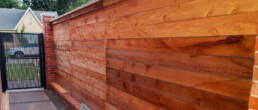
If you have priced out a wood fence in Oklahoma recently, you have probably seen two very different numbers for what sounds like the same thing: a cedar fence. One quote lists Western Red Cedar. The other lists Japanese cedar, often at a noticeably lower price. Both are called cedar, and both look similar on the day the fence goes up. But a few years down the road, the difference between them can be hard to miss. We have built wood fences across central Oklahoma since 2008, and we have strong opinions on this one. Below, we break down how these two woods compare, why it matters in our climate, and how to make the right call for your property and budget.
Why the Type of Cedar Matters So Much in Oklahoma
Wood fences in Oklahoma take a beating. Summers bring long stretches of intense heat and sun. Winters swing between mild afternoons and hard freezes, sometimes in the same week. Spring adds heavy rain, hail, and strong wind. All of that puts constant stress on fence boards as they absorb moisture, dry out, expand, and contract over and over.
Some woods handle that cycle well. Others start to show it quickly through warping, cupping, cracking, and early graying. When you are choosing fence boards, you are really choosing how well your fence will tolerate those swings year after year.
This became a much bigger conversation in Oklahoma a few years ago. When supply chain problems made Western Red Cedar hard to find, Japanese cedar showed up across the market as a more available, lower-cost substitute. It is still widely sold here today, and many homeowners have no idea which type their fence was built with until problems start to appear.
The type of wood also affects everything built around it. A fence is a system of posts, rails, pickets, and hardware working together. When the boards warp or shrink, they pull against fasteners and rails, which can loosen the entire section over time. Choosing the right wood up front protects the rest of your investment.
That is why we never treat material choice as a minor detail. When you request a quote for a wood fence, the type of cedar listed on that estimate deserves just as much attention as the price, the height, or the style.
Western Red Cedar vs. Japanese Cedar at a Glance
Here is how the two compare in the areas homeowners care about most. These observations come from what we see in the field across the Oklahoma City metro.
Durability and Natural Resistance
Western Red Cedar is known for its natural oils, which help it resist rot, decay, and insects. That built-in protection is a big part of why it has been a go-to fencing wood for decades. In our experience, Japanese cedar does not hold up nearly as well in Oklahoma conditions and tends to break down sooner, especially near the ground and in areas that stay damp.
Stability and Warping
Western Red Cedar is a relatively stable wood, which means it tends to stay straighter as it goes through wet and dry cycles. Japanese cedar boards are more prone to cupping, twisting, and splitting as they react to heat and moisture changes.
Appearance Over Time
Both woods look attractive when new. Western Red Cedar typically has rich color variation and weathers to a soft, even silver if left untreated. Lower-grade boards tend to gray, stain, or look worn much faster.
Maintenance Needs
Any wood fence benefits from periodic cleaning and an occasional stain or sealer. Western Red Cedar tends to reward that care with a longer, better-looking life. Boards that are already prone to warping and splitting are harder to keep looking sharp, so homeowners often end up spending more time and money on repairs and board replacements down the road.
Price and Availability
Japanese cedar usually costs less upfront and is easy to find in Oklahoma. Western Red Cedar carries a higher material cost, but it often delivers a much better value over the life of the fence.
Why We Build Our Wood Fences With Western Red Cedar

We build our wood fences with Western Red Cedar, and it is not because it is the cheapest option. It is because we stand behind our work, and we want every fence we install to still look good and function properly long after our crews pack up.
Our reputation was built on word of mouth. When we build a fence for one homeowner, we expect their neighbors, friends, and family to hear about it. That only works if the fence holds up. Using a material we know performs in Oklahoma weather is one of the simplest ways to protect that reputation and your investment at the same time.
Western Red Cedar also gives us flexibility in design. It works beautifully for a full privacy fence, a classic stockade, a modern horizontal fence, or a shadowbox design that looks good from both sides. Because the boards tend to stay straighter over time, the clean lines that make these styles appealing last longer, too.
Of course, great wood is only half of the equation. A fence also depends on what is underneath it. Our team sets posts deep in concrete, plans spacing with wind exposure in mind, and factors in how the fence will be used before we start building. Our founder’s engineering background shapes that approach on every project, from small backyard fences to large residential properties.
When you combine quality cedar with careful installation, you get a fence designed to handle Oklahoma conditions rather than one that starts showing its age after a couple of hard summers. That is the standard we hold ourselves to on every residential fence installation we take on.
Signs a Cedar Fence Was Built With Lower-Grade Boards
Not sure what your current fence is made of? You may not be able to tell from a quick glance, but the way a fence ages can offer some strong clues. Here are some of the most common warning signs we see when a fence was built with lower-quality boards:
- Boards cupping or twisting. Pickets that curl at the edges or twist away from the rails are often reacting poorly to moisture changes.
- Splitting and cracking. Long splits that open up at the ends or around fasteners can point to wood that does not handle Oklahoma’s dry heat well.
- Fast graying or dark staining. All untreated cedar weathers, but boards that turn blotchy, dark, or dingy within a short time may be a lower-grade product.
- Soft spots near the ground. Pickets that feel spongy or crumble along the bottom edge are breaking down sooner than they should.
- Nails and screws backing out. When boards move too much, they can pull against their fasteners and loosen over time.
- Gaps opening between boards. Shrinking boards can leave privacy gaps that were not there when the fence was new.
Some of these issues can also come from poor installation, storm damage, or simple age, so it is worth having a professional take a look. Our fence repair and maintenance team can help you figure out what is going on. If you are weighing a fix against a full replacement, our post on the signs it is time to repair or replace your fence covers what to look for.
Is Japanese Cedar Ever the Right Choice?
We believe in giving homeowners honest options, even when that means talking about materials we do not prefer. So is there ever a case for Japanese cedar? Occasionally, yes.
Some property owners are working with a tight budget and simply need a fence up quickly. Others are preparing a home for sale, fencing a rental, or looking for a short-term solution while they plan a bigger project later. In those situations, the lower upfront cost of Japanese cedar can be tempting, and we understand why.
Here is our honest take. We can install Japanese cedar if a customer specifically requests it, but we cannot warranty it the way we warranty Western Red Cedar. Based on how we have seen it perform in Oklahoma, it would not be fair to promise long-term results from a material we do not trust to deliver them. We would rather tell you that upfront than have you find out the hard way a few seasons later.
In many cases, the price gap is smaller than people expect once you look at the full picture. When we talk through your project, we can often find ways to make Western Red Cedar work, whether that means adjusting the height, choosing a simpler style, or rethinking the layout. Sometimes a different material, such as chain link for a back property line, makes more sense for part of the project. Our goal is to help you land on a fence that fits your budget without setting you up for early repairs.
Western Red Cedar vs. Japanese Cedar: The Quick Takeaway
If you are comparing quotes for a wood fence in Oklahoma, keep these points in mind before you sign:
- Check which type of cedar is listed on every estimate, since “cedar” alone does not tell you much.
- Western Red Cedar offers better natural resistance, stability, and long-term appearance in Oklahoma weather.
- Japanese cedar costs less upfront but tends to warp, split, and wear out sooner in our experience.
- Ask whether the material is covered by the contractor’s warranty.
- Look beyond the boards and ask how posts will be set and how the fence is designed for wind.
- Compare long-term value, not just the initial price.
A wood fence is a long-term investment, and the right material is one of the easiest ways to protect it. A slightly higher upfront cost usually pays for itself when you are not replacing warped pickets every few years.
Get a Free Estimate on a Western Red Cedar Fence
Ready to build a wood fence that is made for Oklahoma weather? Our family-owned team has been installing fences since 2008, and we bring the same care to every project, whether it is a backyard privacy fence or a large property line. We will walk you through your options honestly, explain exactly what materials we are using, and build your fence with the planning and precision it deserves. We serve homeowners throughout the Oklahoma City area and surrounding communities, including Norman, Edmond, and Yukon. Get a Free Estimate today and let us help you choose a cedar fence that holds up for the long run.
Ready to Get Started? Get a Free Estimate Today!
Whether you’re upgrading, repairing, or installing new fencing, we’re ready to help. Contact us for a free estimate and expert guidance from our trusted fence professionals.
Like this article? Spread the word!
Related Posts

Fence Concepts & Construction’s Guide to Oil & Gas Site Fencing in El Reno, OK
Need oil and gas site fencing in El Reno, OK? Explore materials, gates, and security…

What’s the Best Time of Year to Install a Fence in Oklahoma?
Wondering when to install a fence in Oklahoma? See how each season affects your project,…

Chain Link vs. Ornamental Iron: Which Offers Better Security for Your Property?
Comparing chain link and ornamental iron for security? Get an honest breakdown, then Get…